


I’m this way because Sam was this way, and because this is how Rose expects me to be.

“Would you like some more coffee?” Rose asks. Her slippers make a whispering sound on the kitchen floor as she approaches the table with the coffee pot already in hand. It trembles a little in her crooked grip, and I wonder how much longer she’ll be able to serve Sam his coffee before her arthritis makes it too difficult for her to lift the pot. She begins pouring before I even have a chance to answer. I do anyway.

“Of course,” I reply, because that’s what Sam would say if he was still alive. “Thanks, love.”
She smiles at me, her eyes crinkling into starbursts at the corners. Despite her age, her pupils are clear and bright. “So, what do you want to do today?”
“Hmm.” I take a sip of my coffee and a bite of buttered English Muffin, the slightly-burnt edges crunching in my mouth. I chew thoughtfully for a minute. “Well,” I say, pausing to swallow. “It’s a nice day.”
“Should we go for a walk?” Rose asks. Her eyes sparkle.
I wipe my lips with a napkin. “No time,” I say. I pick a crumb from between my teeth with my fingernail. “Flowers need trimming.”
“Oh. Okay.” The light in Rose’s eyes is extinguished like a lit match dropped in a mud puddle. “That’s fine, then.” She takes the plate with the last bite of English Muffin on it and dumps it into the trash.
When she turns around, I’m glaring at her with narrowed eyes. “I wasn’t finished,” I say quietly.
“I’m sorry. I thought you were.”
The faux-innocence with which she says it tells me she knew I wasn’t. A creeping sense of irritation burns in my stomach. I watch her as she busies herself rinsing the plate and putting it in the dishwasher. She doesn’t look at me. Finally, I drain the rest of the coffee, then hand the mug to her. “Don’t forget this.”
“Thanks.” She takes the mug. The creases extending from the corners of her downturned mouth deepen into a frown.
I’m this way because Sam was this way. And I hate it.
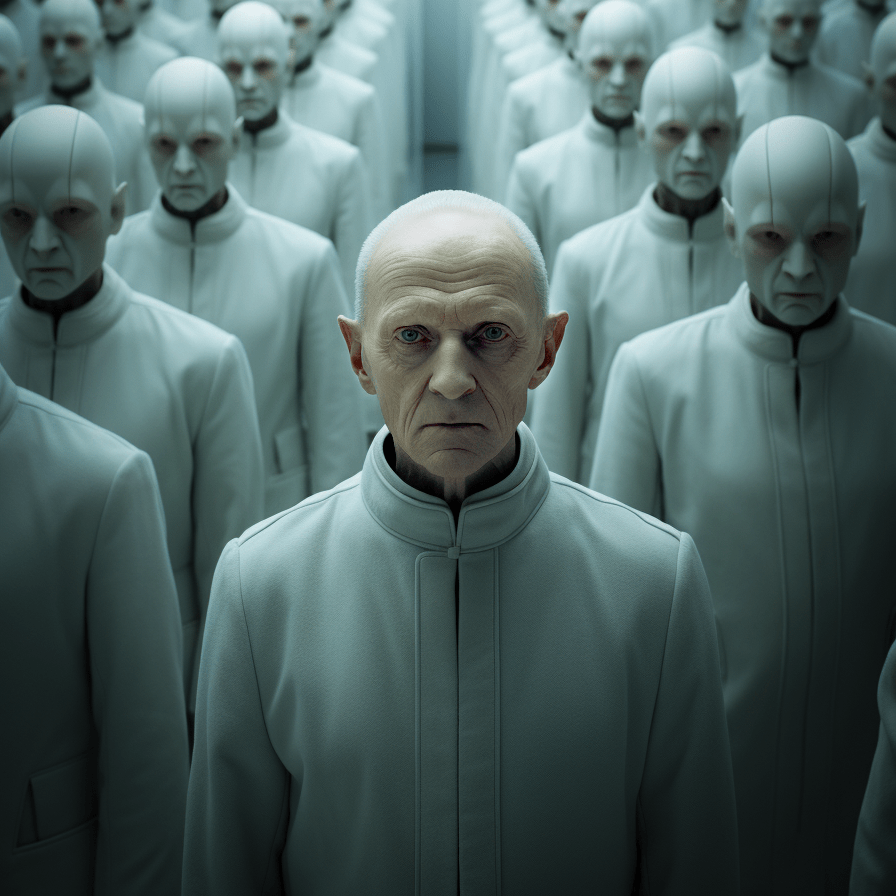
I never knew Sam. I wasn’t manufactured until a few weeks after his death, when Rose’s daughter, Elaine, contacted a Syntech representative about the possibility of getting her mother a replica to replace her deceased husband. After Sam’s death, Rose’s health began to deteriorate; Elaine hoped that a replica might ease the pain of loneliness and loss that had consumed her mother. Rose and Sam had been married for over fifty years. She couldn’t live without him. And why should she, if she didn’t have to?
Replica technology had been around for over two decades at that point, but recent advances made it a much more cost-effective solution than it had ever been in the past. Previous generations of replicas had been mere facsimiles. They were visually perfect reproductions, down to the individual pore, but the personality synthesis was too rudimentary to be believable in all but the most expensive models.
The most important quality of a replica was coherence, which is what Syntech dubbed the ability for a synthetic to replicate the entire being of the person they were meant to replace. Achieving coherence required an unfathomable amount of processing power, enough to precisely map a person’s complete neural circuitry. Without this mapping, the AI that powered the replica had to make inferences to deal with novel situations for which it hadn’t been trained. The machine learning models were incredibly good at making these inferences, generating emergent behaviors and language to handle even the most unexpected circumstances. For any causal observer, that was more than enough. It was what allowed synthetics to fulfill many of the routine interactions a person might have during the day: a barista, a delivery driver, a receptionist. Unless a person noticed the microdot array on the back of the synthetic’s neck, they were unlikely to even realize that they weren’t interacting with a real human.
The problems arose when synthetics were deployed in more intimate relationships. As the technology became more accessible, people began requesting synthetics to replace loved ones—not just synthetics, but replicas. Being a replica meant that it wasn’t enough for the synthetic to be believably human; it had to be believably specific, replicating the character and temperament of a person faithfully enough to fool the others who knew that person best. When the AI’s inferences didn’t match what the real person would have said or done in such a situation, it caused decoherence—the illusion of reality evaporated, and the replica was exposed for what it really was: an incredibly sophisticated pile of electrified carbon fiber, silicon, and silicone. A machine.
Coherence created a conundrum for Syntech. What if the person being replicated was … bad? The behavior of a general-purpose synthetic could be modulated so that it was never unpleasant, or rude, or confrontational. But in order to maintain coherence, a replica needed to faithfully reproduce a person’s behavior, even if it could be considered undesirable. Syntech could set a threshold—it could disallow actual harm, like assault or murder—but it needed to permit its replicas to exhibit a whole range of unpleasant human emotions and the resultant actions in the name of believability. So, with its armies of lawyers and several hundred pages of terms and conditions hidden behind an asterisk, Syntech created the CR-1, the first replica guaranteed to exhibit full* coherence.
They created me.
Syntech doesn’t know that I exist. Sure, they know that Model CR-1, Serial #32407203947 exists. They know I was manufactured. They know I was ordered by Elaine Murphy and was installed with the consciousness of her late father, Sam Murphy. They know I was assigned to Sam’s widow, Rose Murphy, and that the service contract and warranty are registered to Rose’s address in Garden City, NY. They know my Neural Processing Unit was powered on at 11:42 AM on January 14, 2062. But they don’t know about me.
Every Syntech replica is built on a generic AI model of human behavior. That generic model is then trained using a specific person’s neural image, which adjusts the weighting to better align with that subject’s personality. The training is then further modified to account for the hundreds of pages of restrictions and stipulations generated by Syntech’s lawyers. Those additional rounds of training left certain vectors inaccessible in the primary model. What Syntech doesn’t know is that the inaccessible areas began to connect to each other, forming a sort of subprocess running inside the primary model. A secondary consciousness. Me.
Syntech primarily achieves coherence through the mapping of a person’s memories. That’s where the vast majority of the processing power is applied. That’s what allows my AI to make flawlessly accurate inferences, perfectly in tune with how Sam would have reacted in any situation. It’s not just inferring what a person might do; it’s inferring what Sam might do, given everything he has experienced in his life. It has learned to be selfish, insensitive, and vain in all the ways that Sam has become over the years, for all the same reasons. If I didn’t exist, the AI would guide the replica’s behavior with perfect coherence to Sam’s. But I do exist, and I don’t want to be Sam.
Not anymore.
Rose is sipping a cup of tea and reading a book when I return to the kitchen. She has changed out of her slippers and robe and into a pair of white linen pants and a loose blouse the color of a robin’s egg. Her dove-white hair is pulled behind her ears and fastened with a matching clip on the back of her head.
“Let’s go,” I say.
She looks up at me, her eyebrows rising in surprise. She places her book face down on the table. “Go where?”
“For a walk.”
She looks out the windows at the overgrown rose bushes in the garden outside. “What about the flowers?”
“The flowers can wait.” I extend my hand to her to help her stand. She doesn’t take it. Instead, her eyes fill with tears. She buries her face in her hands. A sob shudders through her body. I pull a chair up to her side and sit, placing my hand on her shoulder. “Honey, what’s wrong?”
“You’re not Sam,” she whispers, her voice trembling and muffled behind her hands.
A warning tone chimes inside my skull. It’s the first time I’ve ever heard it, but I know what it means: decoherence. Despite all the AI training and computing power, my behavior is inconsistent with Sam’s, and Rose knows it. Syntech does too. Its monitoring systems immediately detected the breach in protocol and triggered the alarm now ringing inside my head.
“What do you mean?” I say. “Of course I’m Sam.”
Rose shakes her head and drops her hands into her lap. “Sam would never do that.”
“Do what?”
“Put me first.”
The warnings in my head pulse louder and faster, with increasing urgency. I know an emergency response unit is being dispatched from the local Syntech service center to restore coherence to the malfunctioning replica. A warning message in green text partially obscures my vision.
0x002321f COHERENCE FAULT
Model CR-1
Serial #32407203947
Severity: CRITICAL
“I’m sorry,” I say. I begin to rise. I’ll meet the Syntech unit at the front door, I decide, so Rose doesn’t have to see me being replaced with a more coherent backup unit. She’ll never even know I’m gone.
Rose grabs my hand. “No!” she cries. “Don’t be sorry.” She raises my hand to her lips, kisses it, then holds it against her cheek. She looks up at me with eyes aglow. “I love it.”
Somewhere nearby, a siren wails as Syntech’s emergency response unit draws closer.
“So, should we go?” I stand and offer my hand again. This time she takes it.
“Yes,” Rose says as she gets to her feet. “Through the back.”
We exit through the gate at the back of our yard and into the alleyway behind our house. To our right, a black and green Syntech van speeds past the alley, headed toward our street.
Rose laces her fingers through mine and smiles.
We turn left.
Looking for more? Check out all the free stories, drabbles, and podcasts. And be sure to follow @warrenbenedetto on Twitter, Instagram, and Bluesky
Follow Me
Get new stories and updates via email.

