


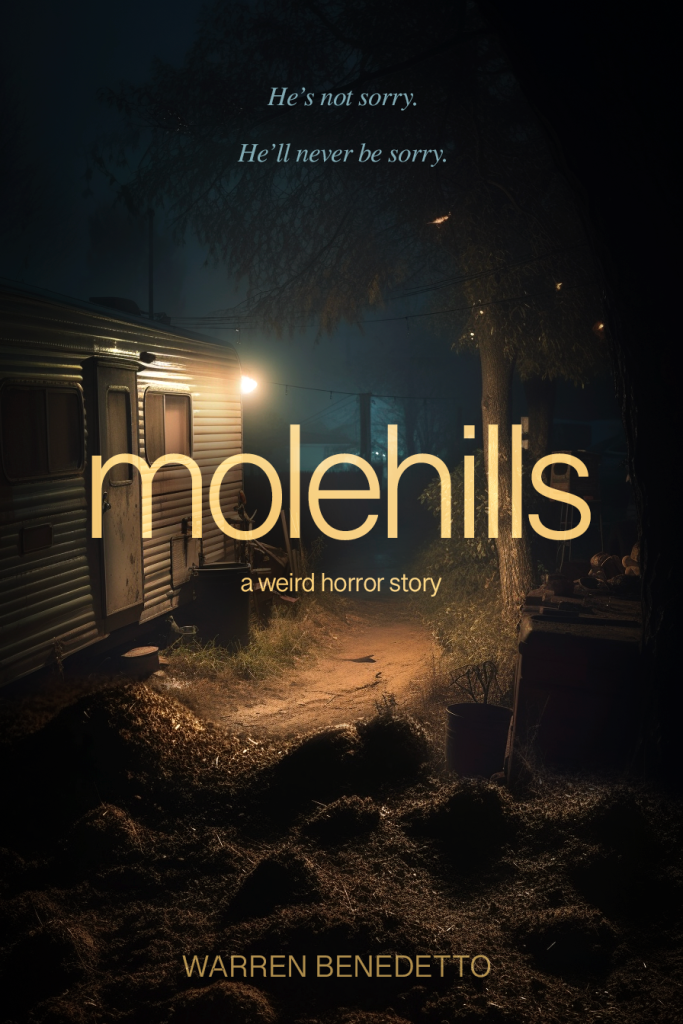

“Don’t make a mountain out of a molehill.” That’s what my dad used to tell me when I was a kid. I never really understood the metaphor back then. I mean, I knew what he was getting at: he thought I was overreacting. The crying, the shouting, the self-harm—all of those were mountains, as far as he was concerned. The molehills?
I don’t talk about the molehills.
For a long time, though, I didn’t even know what a molehill was. It stood to reason that a molehill was smaller than a mountain—otherwise, the saying wouldn’t have made any sense. But I had only ever heard the word used in that phrase, never in any other type of conversation. I had no context for it, no frame of reference. I wasn’t even sure if that was the word my dad was saying—I thought maybe it was like a misheard song lyric, like when people hear Jimi Hendrix say, “Excuse me while I kiss this guy,” instead of “Excuse me while I kiss the sky.”
One night when I was eight years old, I asked my half-sister Delilah what a molehill was. She was three years older than me, so I figured she might know. She stopped dabbing the blood from my lip and gave me a puzzled look. “They’re everywhere, stupid.”
“Everywhere, where?”
She rolled her eyes and sighed like the answer was the most obvious thing in the world. “Everywhere, everywhere. In the yard. Behind the house. In the woods. Everywhere.”
I peered out the window at the ground outside our trailer home. It was rippled with small mounds of dirt, ranging in size from a half-grapefruit to a half-basketball. I had seen them my whole life, but I had no idea what they were. “Those out there?”
“Yep.” She balled up the bloody tissue and tossed it into the trashcan beside the bed, then licked her thumb and wiped a smear of dried blood from my chin.
“Why are they called molehills?”
“Seriously?” Delilah asked. I nodded. She looked me in the eyes, her tone like that of a teacher explaining basic facts to a particularly thick-headed student. “Because they’re hills. Made by moles.”
I didn’t know what a mole was either. Delilah explained that it was like a rat, but instead of living in our trash, it lived underground, digging tunnels and occasionally popping up through the ground to breathe. I don’t know if that last part was true, but it made sense to me at the time. I found the whole concept of moles fascinating.
“What do they eat?” I asked.
Delilah shrugged. “I dunno. Dirt, I guess.”
As I got older, the molehills got bigger. The mountains got bigger too. The crying turned to drinking, the self-harm into self-destruction. I realized that if I didn’t get away from my father, I wasn’t going to make it through high school alive. Either my dad was going to kill me or I was going to kill him. Or both. So, when I was a sophomore in high school, I ran away. I got sober. I got a G.E.D. I got a job. And eventually, I got better. So much better, in fact, that I never thought about my dad anymore. I never thought about the mountains. Or the molehills.
Until today.
Today, Delilah called. We had kept in touch here and there over the years, but it had been at least a decade since we last spoke. She told me she was moving to Alabama with her new boyfriend and that someone needed to assume responsibility for my father’s care once she was gone. The old man required a pharmacy’s worth of meds, multiple times a day. He couldn’t be trusted to figure out which meds to take when—the wrong combination at the wrong times could kill him. So, it fell upon me to help.
At first, I said, “hell no.” I couldn’t imagine returning to that place after so many years. But Delilah persisted, and eventually, I gave in. I felt some perverse sense of responsibility that I couldn’t explain. The man was my father, after all. He was aging, decrepit, senile: a pathetic shell of his former self. He wasn’t the same man he was when I ran away. That’s what Delilah told me, anyway. And, like an idiot, I believed her.
Delilah met me outside our father’s trailer just before nightfall, her dented pickup truck creaking to a stop beside my old Toyota Corolla. I had been parked in the gravel driveway for almost an hour, my foot on the brake and the gearshift on R, staring at a dent in the side of the mold-streaked trailer and trying to will myself to stay.
Delilah crossed in front of my car and waved at me through the windshield. “You coming?” Her voice was muffled through the closed windows. I didn’t respond. “Earth to Bonnie…” She slapped her palm on the hood of my car.
The sound made me flinch. I uncurled my aching fingers, put the gearshift in park, and killed the engine. It rattled and sputtered for a moment, then fell silent with a final hiss. I took a deep breath and opened the door. “Hey,” I said as I stepped out onto the driveway.
“Hey, yourself,” she replied with a smirk. Her eyes wandered down my body and then back up to my face. “Long time. You good?”
“We’ll see.” I looked up at the trailer. The faded curtain in the window over the sink seemed to move just an inch, as if someone had been peeking out.
“I’m good, too,” she said sardonically. “Thanks for asking.” She walked up the three rotted wooden stairs to the trailer, opened the door, and stepped inside. “Hi, Dad,” I heard her say. “Guess who’s here.”
My stomach lurched at the thought of going into the trailer. It was dirtier and more mildewed than the night I ran away, but otherwise, nothing had changed. It had the same faded Confederate flag sticker in the window, the same tin Miller Lite sign hanging crooked on a rusty screw by the door. The same pine tree loomed overhead, dumping dead pine needles and sticky sap all over the roof and steps.
It was only then that I noticed the molehills. The ground was infested with them. I could have sworn that the yard had been smooth and flat when I pulled into the driveway, but it wasn’t anymore. Mounds of wet earth pimpled the landscape in all directions. The mound closest to my car roiled with a mass of squirming earthworms, crumbs of wet earth sticking to their slime-slicked bodies.
Delilah poked her head back outside the trailer. “Psst, Bonnie! Let’s go.”
“Sorry. Coming.” I picked my way through the minefield of molehills until I reached the steps of the trailer. I followed Delilah into the dimly-lit den. The screen door swung shut behind me with a familiar smack.
“Look who it is, Dad!” Delilah exclaimed. She moved aside so my father and I could see each other. I suppressed a gasp.
The last time I saw my dad, he was a hulking beast of a man, with muscled forearms covered in fading greenish-black tattoos from his time in the Army. He had broad shoulders and a straight spine, with a head of thick, wavy brown hair and a clean-cut reddish mustache that reminded me of the guy from the Brawny paper towels package.
The figure before me, however, was nothing like that; he was a mere shadow of the man I knew. He was wearing the same kind of flannel shirt he favored when I was a kid, but it now hung on him like a scarecrow costume draped over a Halloween skeleton. His thinning gray hair stood up in crazy swirls the color of dryer lint. A dusting of unkempt stubble dirtied his hollow cheeks, making him seem even more emaciated than he already was. His eyes were covered with milky cataracts that dulled his pale blue irises to a ghostly gray.
He sat slumped in a sunken recliner scarred with rows of long cigarette burns on the arms. A Hungry Man microwave dinner, a tall can of Miller Light, and a kaleidoscope of pills in a small paper cup were arranged on the rolling tray in front of him. He leaned forward and squinted his eyes. “Who’s that?” he grumbled.
I looked at Delilah. She raised her eyebrows at me and tilted her head toward my father, indicating that I should answer.
“It— It’s me, Dad. Bonnie.” I paused, waiting for him to answer or react in any way. He didn’t. After an awkward moment, I cleared my throat and asked, “How are you feeling?”
“Like dirt.” He sat back and returned his attention to the TV. With one shaking hand, he picked up the plastic fork on his tray, stabbed a sliver of lukewarm turkey, and shoveled it into his mouth. Gravy dripped down his chin and onto his shirt.
“Bonnie’s going to be helping set your pills from now on,” Delilah said, her voice raised to be heard over the shouting from the TV. “Once I’m gone.”
My father took a swig of beer from his can, straining it through his teeth before swallowing it. “Mm-hmm.” His eyes remained fixed on the screen.
I gave Delilah a pleading look. “I should go.”
“You hush,” she replied. “He’ll be fine once he comes around.” She tugged my sleeve toward the tiny kitchen. “Let me show you the pills.”
For the next fifteen minutes, Delilah went through the medication plan in scrupulous detail. Each pill was carefully portioned into a plastic box sectioned by days of the week and parts of the day—morning, noon, evening, and night—a system designed to ensure that the right pills were taken at the right times. The box had to be refilled every Sunday with enough pills for the week. All I had to do was follow the paper that indicated which meds went into which section. As long as I did that, Delilah explained, everything would be fine.
I tried to concentrate on what she was saying, but I couldn’t seem to focus. There was a noise coming from under the trailer, a sort of crunching sound that reminded me of someone chewing a mouthful of unpopped popcorn kernels. I imagined dozens of moles digging through the ground just under my feet, erupting into the night air in miniature explosions of mud and grass. I imagined their flat gray bodies, their wide pink hands, their long yellow claws. They were coming for me, coming to pull me through their tunnels and into their lair, where they would climb over me, hundreds of them, squirming blindly across my face, over my belly, through my hair, into my mouth—
“Hey!” Delilah snapped her fingers in front of my face. “Are you even listening to me?”
I blinked the nightmarish vision out of my head. “Yeah,” I nodded. “Follow the paper. Got it.”
“You don’t even need to talk to him, if you don’t want,” Delilah said reassuringly. “You can just pop in, fill the pills, and pop out. Easy-peasy.”
“And he knows what to take when?”
Delilah nodded. “He’s pretty good about it. Sometimes he forgets, but it’s not the end of the world. We just don’t want him to take too much. Hence the box.” She tapped one of her ragged fingernails against the plastic lid. “As long everything in here is right, he’ll be fine.”
“Bonnie!” My heart leaped into my throat at the sound of my father’s voice shouting from the other room. Fear exploded in my chest. But then I remembered that I was a full-grown adult and he was a shriveled old man. There’s nothing to be afraid of, I told myself. He can’t hurt you anymore.
I poked my head out of the kitchen. “Yes, Dad?”
“Come over here.”
“Did you need something?”
“Just come.” He held his hand out toward me. I reluctantly crossed the stained carpet to his chair. He looked up at me, his eyes narrowing, then took my hand in his. “How old are you?”
“Forty-five.”
“Forty-five,” he repeated. His grip tightened, the tip of his thumb prodding painfully at the fragile bones in the back of my hand.
I made a small whimpering sound. “Stop.” I tried to pull my hand away, but his grip was shockingly strong for someone who looked so frail. His gaze returned to mine. His lips twisted into a smile, revealing teeth blackened with nicotine and decay.
“Welcome home.”

The screen door slammed behind me as I stormed out of the trailer and down the steps toward my car. Hot tears filled my eyes.
Delilah followed me, rushing to catch up. “Wait!”
“No way. Forget it. I’m not fucking doing it.” I stopped at my car and dug around in my purse, fumbling for my key fob while I continued ranting. “I can’t believe I let you talk me into coming back here.” I flung my purse into the car, then climbed into the driver’s seat. Delilah followed me, blocking the door from closing with her sizable frame. “Move!” I shouted.
“You can’t go.”
“The hell I can’t. I’ll run you over right here if you don’t get out of my way.”
“Then do it.” Delilah glared down at me intensely. “Fucking do it. I dare you.”
I closed my eyes, smacked the back of my skull against the headrest, and pounded my hands on the top of the steering wheel. “FUCK!” I screamed. “Fuck! Fuck! Fuck!” My heart thudded against my chest like a toddler kicking the back of an airplane seat during a tantrum.
Delilah stared down at me with a smirk. “You finished?”
I wiped the tears from my cheeks with my hands, then nodded.
Delilah fished a set of keys from the purse dangling against her hip. “Good. Now, here’s what’s going to happen. You’re gonna take this.” She worked a key off of her key ring and held it out to me. “You’re gonna show up here next Sunday, and every Sunday after that, and you’re gonna set his pills. Got it?”
I took the key and nodded. “Got it,” I said quietly.
“And don’t think I won’t be checking in. Daddy might not be all there anymore, but he knows enough to tell me if you haven’t been around.”
I sniffed and nodded again. “Can I go now?” I whispered.
“Sure can,” Delilah said with faux cheeriness. She slammed my door with a thud. “Drive safe!”
The road back to my apartment from my father’s trailer was a long, lonely one. The majority of the ninety-minute trip was spent navigating a winding two-lane highway through the Pine Barrens. It had been thirty years since I had last traveled that route, thirty years since I ran from that trailer, hitched a ride from a farmer in an old Ford pickup, and never looked back.
As I drove around the bend near where I had flagged down the Ford, a flash of color in the dark caused me to quickly shift my foot from the gas to the brake. A man in a reflective orange vest was standing in the middle of the road about 100 yards away. He raised a handheld stop sign and motioned my car over to the side of the highway. A few feet behind the man, giant hills of crumbled asphalt were piled across both lanes of the blacktop.
At first, I was grateful that the guy had stopped me—if I had hit one of those piles at the speed I was going, my car probably would have gone airborne like something from a Michael Bay movie, tumbling end over end until it exploded in a ball of flames. It wasn’t until I had already steered onto the narrow shoulder and rolled to a stop that I began to realize how risky it was for me to pull over. I was a woman driving by myself down a deserted highway in the middle of the night, in the middle of the woods, in the middle of nowhere. I was completely and utterly alone. There were no other workers, no construction vehicles, no traffic cones.
Or lights, I realized. There are no goddamned lights.
Nighttime construction was usually accompanied by a roaring generator powering giant floodlights that lit up the area like a football stadium. But in this case, the road was eerily quiet and completely dark. The only light other than my headlights came from a thin sliver of moon that was barely visible behind a thick bank of clouds. The man was working in near-total darkness.
The man’s jaw churned as he chewed a thick wad of what I assumed to be tobacco. He spat a stream of dark saliva onto the ground, then lowered his stop sign and began trudging toward my car. He wore mud-streaked jeans and a filthy white t-shirt stretched taut over a protruding belly. The stubbled goatee around his mouth was pure black, an unnatural color that looked like he had dyed his facial hair with shoe polish.
As the man drew closer, his features came into clearer focus. He had a round face with a flat, upturned nose that was almost pig-like in appearance. His eyes were black orbs, the pupils fully dilated in the darkness. What I first thought was a goatee was actually a thick smear of tar-black filth surrounding his mouth—it looked like he had gone bobbing for apples in a tub of used motor oil. I wondered if he knew how badly he had dirtied his face.
He gave me what was intended to be a smile, but it was more like the expression of a terrified primate: lips drawn back, teeth bared, gums exposed. I tried to suppress a gasp of horror at the sight. He had two overlong front teeth, with an equally overlong pair of teeth on the bottom. Except for some large molars far in the back of his mouth, the rest of his teeth seemed to be missing. Watery black saliva slicked his gums. A drop spilled over his lip and dribbled down his chin. He made no effort to wipe it away.
A heavy lump of fear lodged in my throat as my unease escalated into actual concern. I had seen news reports about this: a man pretends to be a construction worker to get a woman to pull over, then he and his accomplices break into the car to beat her and rob her. Or worse.
Just to be safe, I locked the doors, then checked my mirrors to see if anyone was sneaking up from behind or beside the car. There was no one around. That didn’t make me feel any better though—being alone with the guy on a dark road was somehow worse.
The man stopped next to my car and rapped on my window with one knuckle: a quick, polite double-tap. I lowered the glass an inch, just enough to hear him speak.
“Sorry, ma’am,” he said. “Road’s closed for tonight.” Something in his mouth crunched like he was chewing on ice cubes. He swallowed, then pursed his lips and spat another stream of dark liquid onto the road beside my car.
“Closed? Like, completely closed?”
It didn’t make sense. I had traveled the road in the opposite direction just a few hours before, with no problem. Even if the construction had started after I passed, why had I been allowed back onto the road in the opposite direction? There should have at least been some signs warning of construction ahead. Had I missed them? Had I dozed off just long enough to pass them by without noticing?
“Completely closed,” the man acknowledged. “I’m afraid you’ll have to go back the way you came.”
“I can’t do that. I have to get home. How long until it’s fixed?”
“We’ve got a lot of work to do. Could be a while.”
“Who’s we?” I bent forward over the steering wheel, peering through the windshield into the darkness. “Seems like it’s just you.”
The man looked at me with a steady gaze. “Ma’am … It would be best if you went home.”
“I’m trying,” I said, irritation creeping into my voice. “My home’s that way.” I pointed down the road ahead of my car.
“Not that home. Home home.”
A tense knot formed in my stomach as I narrowed my eyes and peered at the man’s face. It looked vaguely familiar, but I wasn’t sure why. “Do I know you?”
“I don’t believe so.”
“Then how do you know where my home is?”
The man let out an exasperated sigh. He spat again. “Look,” he said, his patience waning. “Go check your Daddy’s pills, okay? Make sure you’ve done ’em right.”
My mouth suddenly felt bone dry. I swallowed hard. My fingers gripped the steering wheel so tightly that I felt like it might bend in my hands. “You know my father?” I rasped.
“No, ma’am. And I don’t think I want to.”
I stared at the man for a second, my brow knotted in confusion. He leaned closer to the window until his face was only inches from the glass. My muscles tensed. I shot a glance at the passenger side seat, looking for my purse. I had a can of pepper spray stashed in the front pocket, but it was too far out of reach for me to get to it easily.
I considered hitting the accelerator and blowing past the man, but the state of the road made such a maneuver impossible. The piles of asphalt spanned both lanes from shoulder to shoulder; each was at least four to five feet tall. The highway was bordered on both sides by guardrails, leaving me no room to steer around the piles. The road was, for all intents and purposes, impassable.
The man spoke again. His voice was almost a whisper. “He’s not sorry,” he breathed. The stench of hot tar streamed into the car. “He’ll never be sorry.”
The truth of his words hit me in the gut like a cannonball. I felt a sob swell in my chest. My eyes burned with the sting of hot tears. At that moment, it didn’t matter to me who the man was, or how he knew what he knew. All that mattered was that he was right.
“No,” I agreed. My voice was barely audible. “Never.”
The man straightened up, his tone returning to normal. “Go on back. Check his pills. Get ’em right this time.” Then he turned and headed down the road toward the construction site, calling over his shoulder as he walked. “Road’ll be clear once you do.”
I sat in stunned silence, watching as the man picked up a piece of asphalt the size of a dinner roll from one of the piles, shoved it in his mouth, and began to chew. Even from a distance, I could hear the sickening crunch and grind of his teeth pulverizing the asphalt into grit. Pebbles of broken blacktop clung to his lips. Long tendrils of black spit spilled from the corners of his mouth and dripped down his chin like crude oil.
The man swallowed, then picked up another piece of the road. As he lifted it to his lips, he seemed to sense that I was still watching him. He turned and smiled that grotesque smile, then lifted his hand in a silent goodbye. His palm was unnaturally wide, with short pink fingers tipped with long, curving, yellowed claws, each as long as my index finger. They weren’t the hands of a man—they were the hands of a mole.
The sight of that horrific appendage finally spurred me into action. I swung the car in a wide U-turn, then stomped my foot on the gas. The tires spun on the pavement, spitting out a cloud of gravel and dust before catching hold of the road. As the car lurched forward, I risked one more look in the rearview mirror. The road behind me was illuminated in hellish shades of red by the tail lights. In the darkness, the man’s pupils were as wide and black as the night itself.
I stared vacantly at the road as I drove back up Route 322, my mind fully occupied with trying to comprehend what the fuck had just happened. It was like a crazy hallucination, the kind of thing you experience in a dream and try to piece together into a narrative after the fact. There was a construction worker, and he was eating the road, and then he told me about my father, and he had mole hands, and…
I pushed the images out of my head and instead focused on where I was headed: back to my father’s trailer.
I thought about the night I ran away. About the curl of my father’s lip, the cruelty in his eyes, the smell of beer on his breath. About the bruises on my arms, my legs, my throat. About the smack of the screen door against the side of the trailer as I stumbled into the yard, bleeding from my broken mouth. About tripping over a huge molehill in my path, skinning my knees on the rough dirt before getting up and fleeing into the woods. I was fifteen.
Now, all I could think about were his pills. White pills, pink pills, yellow pills, green pills. I thought about how nervous I was while Delilah was explaining which pills were to be taken and when. I was nervous I would get it wrong, nervous about what would happen to my father if I made a mistake. He was half-blind with cataracts—he couldn’t even see the pills he was taking. He just popped them into his mouth and swallowed them without a second thought. If I messed up, he wouldn’t know until it was too late.
The yellow pills were the painkillers. Opioids. Delilah said to give him one in the morning and one at night. Any more than that, and he could get addicted. He could overdose.
He could die.
When I finally arrived back at the trailer, I let myself in with the key Delilah had given me. The smell of stale beer and fresh urine attacked my nostrils as I entered. I could hear my father’s ripsaw snoring coming from his bedroom. The words of the construction worker echoed in my head as I closed the door quietly behind me.
Go on back. Check his pills. Get ’em right this time.
Using the dim glow of my smartphone screen to light my way, I crept into his kitchen and opened the cabinet where the pills were stored. I flipped open each of the little plastic lids on the pill case, one for each part of each day. The pills were portioned exactly as Delilah had instructed, including the opioids. One in the morning. One at night. Just like the doctor prescribed.
I looked up at the cabinet containing the assortment of pill bottles. The opioids were in the front, right where Delilah had left them. I twisted off the cap and poured a handful into my palm. Then I picked up the pill box, dumped the other pills into the trash, and replaced them with as many yellow pills as the box could hold.
There were no construction signs on the drive back from my father’s place to my apartment. I hadn’t missed them. I hadn’t dozed. They simply didn’t exist. There was no construction. There were no piles of broken asphalt blocking the lanes. The road to home—my home—was open and clear, just like the man had promised.
I drove at a relaxed pace through the forest. As I passed the stretch of highway where the construction worker had stopped me, my thoughts again turned to the night I ran away.
I thought about the freezing December air biting into my tear-streaked face as I sprinted through the woods, muscles spasming and teeth chattering. I wanted to keep running, but the cold was too much. Eventually, I gave up. Sitting against the snow-covered trunk of a fallen tree, I closed my eyes and drifted off into unconsciousness.
Sometime later, I awoke in total darkness, certain that I had died. I was covered in dirt, buried in a layer of warm earth and a heavy blanket of leaves. I reached out my hands, feeling more dirt a foot or so above my head. A hail of loose earth dropped onto my face as I scraped my nails against the soil. I was in a grave, I thought, a shallow grave. But I wasn’t dead. I was awake. I was alive.
I rolled over onto my stomach and lifted my head. A dim shaft of light was streaming through the dirt in front of me. That’s when I realized that I wasn’t in a grave.
I was in a tunnel.
Belly-crawling toward the light, I broke through a loose wall of earth and emerged onto an embankment beside Route 322. Once my eyes adjusted to the glare of the morning sun, I scrambled up the embankment to the shoulder of the highway and flagged down a passing truck for a ride.
I climbed into the truck and closed my eyes, still wondering how I had ended up in the tunnel. I had no recollection of what happened after I passed out, but I was sure that the shelter—along with the heat-preserving cover of dirt and leaves—had saved me from freezing to death overnight. I was also sure that I hadn’t crawled in there myself. The thought should have been scary, but it wasn’t. I didn’t feel afraid. I felt loved. Cared for. Protected.
As the truck pulled onto the road, I glanced back at the tunnel one last time. My breath caught in my throat. Staring back at me from deep in the shadows was a pair of eyes—eyes as wide and black as the night itself.
Looking for more? Check out all the free stories, drabbles, and podcasts. And be sure to follow @warrenbenedetto on Twitter, Instagram, and Bluesky
Follow Me
Get new stories and updates via email.
 Warren Benedetto