

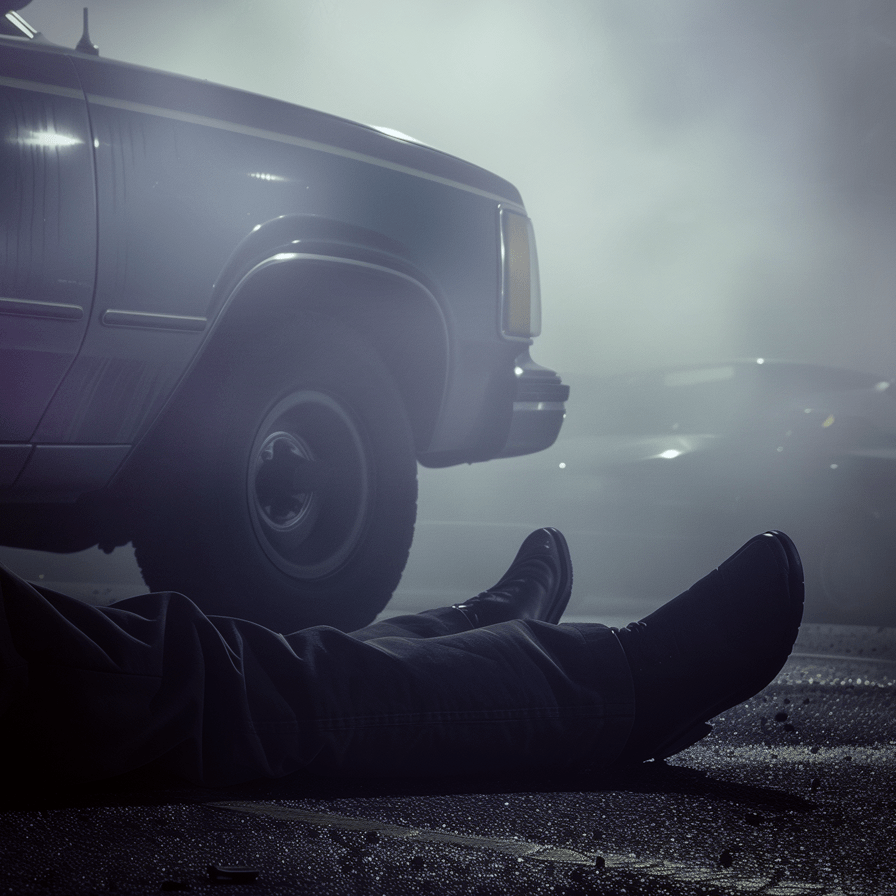


If you were to ask me to list the Top Ways I Might Die Someday, “decapitated in a Safeway parking lot” wouldn’t have been at the top of the list. It would have been way, way, way down at the bottom, somewhere between “getting crushed by a falling piano” and “drowning in a tragic pudding accident.”
What a difference a couple of days makes.
I looked around at the gaggle of survivors huddled in the relative safety of a shallow drainage culvert at the edge of the parking lot, thankful for the extra twelve inches of headroom afforded by the dip in the pavement. It wasn’t much, but it was enough to allow everyone to sleep with relative ease for the first time since this whole nightmare began. The telltale signs of the survivors’ struggle were everywhere: holes worn through the elbows and knees of their clothes, their bellies blackened with mud and dust, the skin underneath scraped and scabbed. There was a pregnant woman. An elderly couple. A sickly-looking child. A trio of homeless teens. And … Grady?

Where’s Grady?
I rolled onto my side and tried to see as far across the parking lot as possible, hoping that maybe the guy had crawled back into the Safeway to scavenge for more supplies. I couldn’t imagine there was anything else worth taking—anything that could be safely reached—but maybe he had a new idea. There was nothing left on the bottom shelves, that was for sure. The place was already picked clean by the time we crawled in. I had used the hockey stick I scavenged from a sporting goods store to sweep the higher shelves in hopes of finding something—anything—still up there, but with little luck. At one point, I touched the edge of what felt like a can of food, but I couldn’t get a good enough angle on it to sweep it off the shelf to the floor, where we could safely retrieve it.
We had originally planned to spend the night inside the store, but that plan changed once we crawled inside. The floor was sticky with semi-congealed blood. Headless bodies lay in various states of decomposition. Some of them were otherwise intact, but several had been mutilated by some sort of scavengers. I wanted to believe the damage to the bodies had been caused by feral dogs or hungry rats, but I knew in my heart that the wounds were far too clean. The bodies hadn’t just been chewed—they had been filleted. If I’d had anything in my stomach at the time, I would have vomited at the realization. People did that.
There was no sign of Grady in the direction of the Safeway, so I rolled over and looked out toward the road. The ceiling of ash-gray fog hovering about two feet above the ground obscured everything except for the tires of abandoned cars and the low curbs marking the entrance to the lot. A few more headless corpses were crumpled behind the rear bumper of what I assumed to be a minivan. It looked like a family: two parents, plus a baby in a carrier strapped to the father’s chest. The baby’s face was smeared with congealed blood that had presumably spilled from its father’s neck when he was decapitated. The sight made me realize that the baby still had its head, which led me to wonder how it might have died. Starved to death, probably.
A wave of despair swelled in my chest as I thought of my own family. My daughter, Krista. My wife, Becky. My son, Caleb. I didn’t know where they were, or if they were even still alive. I hoped that they had figured out to stay low, to keep their head out of the fog, but I couldn’t be sure.
As I wiped my hand across my face, a blur of motion caught my eye. A faded red baseball cap was visible just beyond the wheels of the minivan. And it was rising.
“Grady!” I hissed. “What are you doing?”
The red hat turned in my direction. Grady’s pale, haggard face stared back at me from where he was lying belly-down on the asphalt. He smiled. There was no joy in his expression. “It’s okay,” he said. “You’ll see.” He began to raise himself onto his elbows and knees.
“No!” I belly-crawled frantically out of the culvert and onto the parking lot, being careful to stay as low to the ground as possible. The scabs on my elbows and knees blossomed with fresh blood. “Stay down, goddammit!”
Grady hesitated. He rolled onto his side and faced me as I scrambled to catch up with him. His head was perilously close to the fog. “Don’t you get it?” His eyes blazed with defiance. Sweat trickled from under his cap. “They’re doing this. It’s all part of their plan.”
I reached Grady’s position and pulled him down to the ground. “There is no they! And this,” I motioned to fog overhead, “is everywhere. It’s not just here. It’s all over the world right now.”
I wasn’t making that up. There were enough news reports from around the globe to know that the fog wasn’t isolated to just our city, or even to our country. But to know that, you had to be watching the right channels, reading the right websites, following the right people on Twitter or Facebook. If you weren’t, it was likely you were getting an entirely different story. You got the conspiracies. The propaganda. The lies.
The TV stations and Internet went offline after the first day, but the damage had already been done. Whatever information a person got when the whole thing started cemented their interpretation of everything they experienced from then on. No amount of contradictory information could change that. It was like they were living in a completely different reality. In some ways, I envied them. I would have loved to have lived in a different reality, one where everyone was safe, where everything that was happening was a lie. But the bodies littering the ground told a different story, evidence of a reality that was impossible to ignore. For me, anyway.
But not for Grady.
“Everywhere? Really?” Grady barked out a laugh. “That’s exactly what they want you to believe, man. Keep your head down, don’t stand up for yourself. Well, that’s not how we do things around here.” He tapped the American flag patch on the side of his camouflage jacket. “Nobody’s gonna put a boot on my face. If I want to stand, I’ll stand.”
I gestured around the empty parking lot. “There’s no boot on your face, man. We’re just trying to stop you from dying.”
Grady jerked his arm out of my grip. “I’ll take my chances.”
My voice rose with frustration. “Damn it, Grady! It’s not just about you! You could draw attention to them too.” I pointed at the other survivors. The commotion had woken some of them. Their eyes glistened with fear as they waited to see what Grady might do. “You could get us all killed.”
“It ain’t real,” Grady insisted. “It’s a hoax. Think! Have you ever actually seen one of the things up there?”
“No, but I’ve seen what it does to people. So have you.” I put my hand on his shoulder. “C’mon, man. You saw what happened to Cheryl.” I noticed a brief flicker of doubt cross Grady’s face. Then it dimmed, replaced with something else, something darker: denial.
“I don’t know what I saw.”
I stared at him in disbelief. Even after watching his wife die in front of his eyes, he still wasn’t willing to acknowledge the truth, to admit he was wrong.
“It’s like my dad used to say,” he announced as he began to stand. “It’s better to die on your feet …” His head and shoulders disappeared into the fog. “… than to live on your knees.”
Suddenly, a telltale screech pierced the air. A hulking shadow swung through the fog, swooping past with a shriek and taking Grady along with it. All that remained was a fine mist of atomized blood hanging in the air.
A moment later, something red and wet thudded to the ground nearby. It was Grady’s hat. The top half of his head was still inside.
Well, Grady, I thought. I hope your dad was right.
Then I crawled back toward the remaining survivors. On my knees. Alive.
Looking for more? Check out all the free stories, drabbles, and podcasts. And be sure to follow @warrenbenedetto on Twitter, Instagram, and Bluesky
Follow Me
Get new stories and updates via email.
 Warren Benedetto